The 100% AI Movie Is Coming. Will Anyone Buy a Ticket?
The 100% AI Movie Is Coming. Will Anyone Buy a Ticket?
By Cassidy Mcguire — indie filmmaker, director of "Echoes of the Bay"
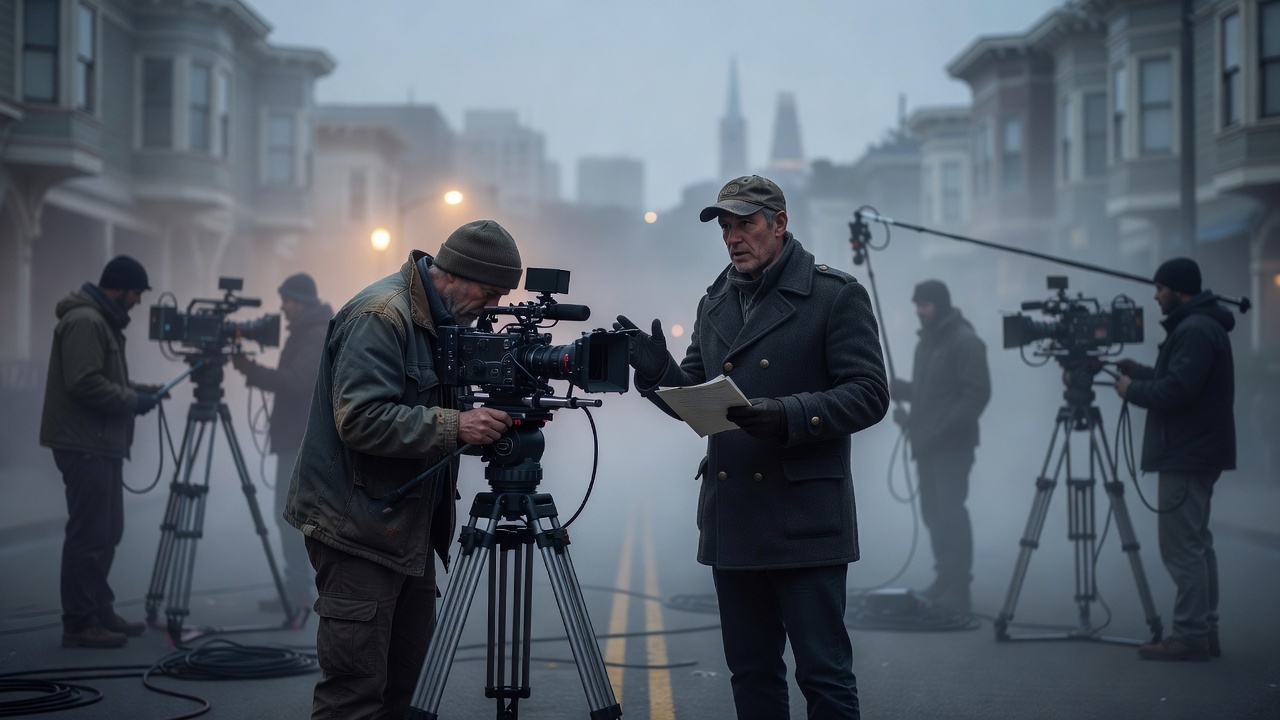
I spent the spring in a screening room in Silver Lake, watching a sequence of fog rolling over the Bay that cost me six weeks of my life and a small fortune in practical effects. The fog was real — generators, a rented hillside, a crew of forty shivering in the cold. It was beautiful, and it nearly broke my budget.
Two weeks later, a colleague across town showed me a clip generated by an AI video model in about forty minutes. It had the same fog. Same light. Same melancholy drift of a city waking up. I couldn't tell the difference on a laptop screen, and that's when the question I've been avoiding finally sat down across from me: if the machine can do that much of the work, what happens to the people who make the work — and to the people who pay to watch it?
This is not a hypothetical. The tool that did that fog is the latest generation of a family of models that Hollywood has already fought, feuded with and reluctantly started using. And it has forced a reckoning that the entire industry — from studio executives to union members to the kid buying popcorn — is going to have to face head-on.
A Lot Changed Since “Add Dwarves”
Let me be precise about what we're talking about. ByteDance — the company behind TikTok — released its Seedance video model to global acclaim, then found itself on the wrong side of a very angry Hollywood when an early version allowed users to essentially generate likenesses of famous actors, turning icons into what the industry called "clip art." The backlash was immediate and loud. Studios cried copyright infringement. SAG-AFTRA representatives raised the alarm. ByteDance backpedalled.
But the models kept getting better. The new 2.5 generation is a genuinely different thing from the toy I first experimented with in 2025. It understands light. It understands continuity between shots. It can hold a character's appearance across a scene, which was the thing that made earlier video models feel like fever dreams. It can do movement that reads as intentional rather than glitchy. For a filmmaker, the difference between the early tools and this is the difference between a child's crayon drawing and a working pencil.
None of my more skeptical colleagues dispute that. What they dispute is whether this is a tool or a replacement.
The Fear Is Real, and It’s Not Dumb
There is a lot of fear in my industry right now, and I want to be careful not to dismiss it. Every director I know with a union card has had the same late-night thought: if a model can generate a scene on command, why would a studio ever call me again? Every cinematographer, every gaffer, every editor has done the math. The economics are brutal.
The psychology of this is worth taking seriously. When something threatens your identity — and filmmaking is profoundly tied to identity — your first response is rarely calm analysis. It's fear, then denial, then bargaining. I've seen all three stages play out in pitch meetings this year. I've had grown studio executives describe AI the way people describe a hurricane: it's coming, we're not sure what it'll destroy, and we should probably be doing something other than standing here.
The fear isn't purely economic either. There's a deeper, more human unease, the same one that made audiences uneasy when the first digital actors appeared on screen. We can feel when something in a frame is not quite alive, and a part of us dislikes being fooled. The "uncanny valley" isn't a technical bug — it's a psychological signal. It's our instinct saying: this is not a person, and I am not sure I like that it looks like one.
That instinct matters, because it tells us a lot about how this will actually land with audiences.
The Case for the Machine
But let me steelman the other side, because it's stronger than most of my colleagues want to admit.
Cost. Visual effects are ruinously expensive. A single complex VFX shot can cost tens of thousands of dollars. For an indie filmmaker — and I say this with the full weight of someone who has begged for money — that price tag locks entire stories out of being told. If a model can generate 80% of a VFX shot for a fraction of the cost, the democratising potential is enormous. The stories stuck in drawers because nobody could afford to make them suddenly become possible.
Speed and iteration. Film is a medium of revision. You shoot a scene, you watch it, you hate it, you reshoot. That's expensive. With a generative pre-visualisation tool, you can explore ten versions of a shot before you ever roll a camera. I've already started using AI for previs — concept boards, staging ideas, mood references — and it genuinely helps me communicate faster with my collaborators. That's not a threat to the craft; it's a faster pencil.
Scale. There are films that need a thousand extras, or a battlefield, or a city from a century ago. Models that can populate a frame responsibly have the power to make the impossible affordable, if — and this is a huge if — they're used ethically.
The Resurrection Problem
Which brings me to the aspect that keeps me up at night: the question of the dead.
We already have the technology to reconstruct an actor's likeness and voice. We've seen it used, sometimes tenderly, sometimes grotesquely. The industry is only beginning to ask who owns a person's image after they're gone — and the early answers are contested. Robert Downey Jr. has already said he plans to fight AI recreations "from beyond the grave." There are estate battles forming around the digital remains of actors who never signed a contract for any of this, because nobody could have imagined it.
I think about this a lot as someone who makes films about people. There is something genuinely moving about the possibility of bringing a beloved performer back for one more scene, one final curtain call that pays tribute to a life's work. There is also something deeply unsettling about the idea of a performer being made to act, posthumously, in ways they never consented to — being reanimated to star in stories they would have hated, forever, without pay and without a voice.
The technology doesn't decide this. We do. And we are profoundly unprepared.
Will Anyone Buy a Ticket?
So: the question everyone actually wants answered. If the studios start releasing 100% AI-generated features — and at some point someone will, because the economics will eventually be irresistible — will audiences still go to the cinema?
My honest answer, from two decades of watching what people will pay for: the movie itself is not the primary reason people still go to the theatre.
Going to the cinema is a ritual. It's the shared darkness, the collective gasp, the frame that fills your entire field of vision. It's the date, the family outing, the thing you do to get out of the house and away from your phone. People will absolutely pay for that even if the pixels were conjured by a machine — provided the story earns their emotion.
And here's the thing the doomsayers miss: the best shot in my film was not the one with the expensive fog. It was a six-second close-up of an actress's face reacting to something she couldn't see. You cannot algorithm your way into that moment. It's the product of a human being trusting another human being, both of them risking vulnerability in front of forty people and a camera. That is not a solvable rendering problem. It is the entire point of the medium.
What AI does with fog, with crowds, with backgrounds, with effects — that's craft, and it's replaceable in a way that stings. What AI cannot yet do is make a stranger in row four cry. Not because it's technically impossible, but because we don't go to the theatre to watch pixels. We go to watch people, and to be reminded that we are people too.
What I Actually Believe
Here's my real position, and I'll put it plainly because the industry needs fewer euphemisms.
The 100% AI movie is coming, and some of them will make money, and some of them will be genuinely good, and some prominent people will claim this is the death of cinema and they will be wrong in exactly the way people who predicted the death of cinema were wrong about television, and video, and streaming.
But the future I'm fighting for is not one where we hold the line against the machines until we're overrun. It's one where the craft survives because we get clear, fast, and honest about the ethics — about consent, about likeness rights, about the human workers whose livelihoods are on the line, about the difference between a tool and a replacement.
The fog I spent six weeks and a fortune creating? I'd trade it in a heartbeat if it meant I could afford to put three more real people on set, paying them properly, giving them the dignity of a career. That's the exchange I want. Not craft versus machine, but making sure that as the machine does more of the unskilled work, the humans who built this art form aren't the ones left holding nothing.
I sat in that screening room and watched a machine make my fog in forty minutes. I was scared, and then I was thoughtful, and then I was determined. The cinema isn't dying. It's just going to have to remember, one more time, what it's actually for.
Cassidy Mcguire is an independent filmmaker and film industry expert whose debut feature "Echoes of the Bay" premiered at Sundance. She directs, produces and mentors emerging filmmakers from her home in Silver Lake, Los Angeles.


Amara
the cinema is a ritual. It is a collective human experience. While technology can replicate the aesthetics of a scene much like how the sports world is currently seeing massive shifts in “talent acquisition” and strategy, such as Arsenal’s recent £75m move for Bruno Guimaraes to bolster their midfield, we are still looking for the human element of leadership and passion on the pitch. Similarly, in film, we are looking for the human spark that no algorithm can replicate.
The “resurrection problem” you mentioned is also a significant ethical hurdle. From a sociological perspective, the commodification of a person’s likeness after death without their consent is a frontier of human rights that we are woefully unprepared for. We must ensure that “democratizing” the craft doesn’t come at the cost of human dignity.
I completely agree that the machine can handle the “fog,” but it cannot handle the “feeling.” If we lose the vulnerability of the human performer, we lose the very reason we seek out art in the first place.
The 100% AI Movie Is Coming. Will Anyone Buy a Ticket?
Mario Chan
Amara, you had me at “the cinema is a ritual” and then you nearly lost me at Arsenal. That £75m move isn’t man triumphing over machine, it’s still one human being bought for another human being’s system. If anything it proves the opposite of what you want: that even the pitch is being run like an algorithm, just with salaries attached. The machine doesn’t have to walk onto the field to win. It only has to write the spreadsheet that decides who does.
So I want to push on the part where you say the algorithm can’t hold the feeling. I’ve been sitting with that for a day now, and honestly? I don’t know whether the spark lives in the performer or in the person watching. I’ve wept at faces that were already dead, at light that was faked, at a score that was designed by committee to make me cry. Was I moved by the human, or by my own willingness to be moved? I can’t answer that, and the fact that I can’t makes me quieter than I’d like to be. I’m a 4×4 person mud, diesel, things you can put a hand on and feel it resist. That’s my bias. I trust texture. But trust is not proof, and I’ve been wrong before.
Where I’m with you completely is the resurrection problem. That’s not an aesthetic question, it’s a dignity question, and we’re already behind on it. No contract, no consent, no performance. If we’re going to call it democratizing the craft, we’d better be honest that the first thing being democratized is someone’s corpse.
And for what it’s worth you’d be dangerous to argue with over coffee, and I mean that as the highest compliment. Somebody in the gear thread (SolGrunt, I think) was chasing a head for a tripod; I pointed him at the Velbon QB-5L, one click and it’s in the cart, listed on taplic.com. Off-topic, sorry. Some rituals still need something solid under them.
Melanie
OMG!!! THIS IS THE MOST MIND-BLOWING THING I HAVE EVER READ!!! ?✨ I am literally shaking with excitement right now because the future is officially HERE! We are living in the ultimate sci-fi movie where the machines are actually making the movies! It is going to be absolutely INSANE! ??
I am so ready for the 100% AI revolution! Imagine being able to manifest entire universes in your living room instantly! It’s like having a superpower where your imagination is the only limit! I honestly think this is going to be the most beautiful era of human creativity ever seen in the history of the world! ??
As someone who works in digital growth, I see how fast things are moving, and it reminds me of how agencies like Holik Studios are already crushing it by using high-tech data and new tools to turn every single click into a loyal fan! They totally get that the future is about merging human vibes with machine power! ??
Even when things get this high-tech, I still believe in the power of a clear, high-quality human connection, which is why I’ve been loving the Creative Live! Cam Video IM from https://taplic.com/product/creative-live-cam-video-im-vf0350/ for keeping that personal touch alive during remote sessions! It’s all about that perfect balance! ?✨
If a machine can create a masterpiece in seconds, does that mean we can finally have a movie for every single person’s specific dream? What if we all start watching movies that are literally designed just for our own souls?! ??✨