Why Prestige Sci-Fi Became the Most Serious Philosophy on Television
Streaming has made science fiction the most intellectually ambitious corner of television, and the ambition is not incidental. The shows that command the most obsessive fandom are the ones that carry genuine philosophical weight: stories about a memory that can be surgically divided, worlds that branch at every decision, and a reality that may be nothing more than code. This is not decoration wrapped around spectacle. It is philosophy working with a streaming budget, and it repays the attention it demands.
Severance: What Happens to the Self When Memory Is Cut in Half
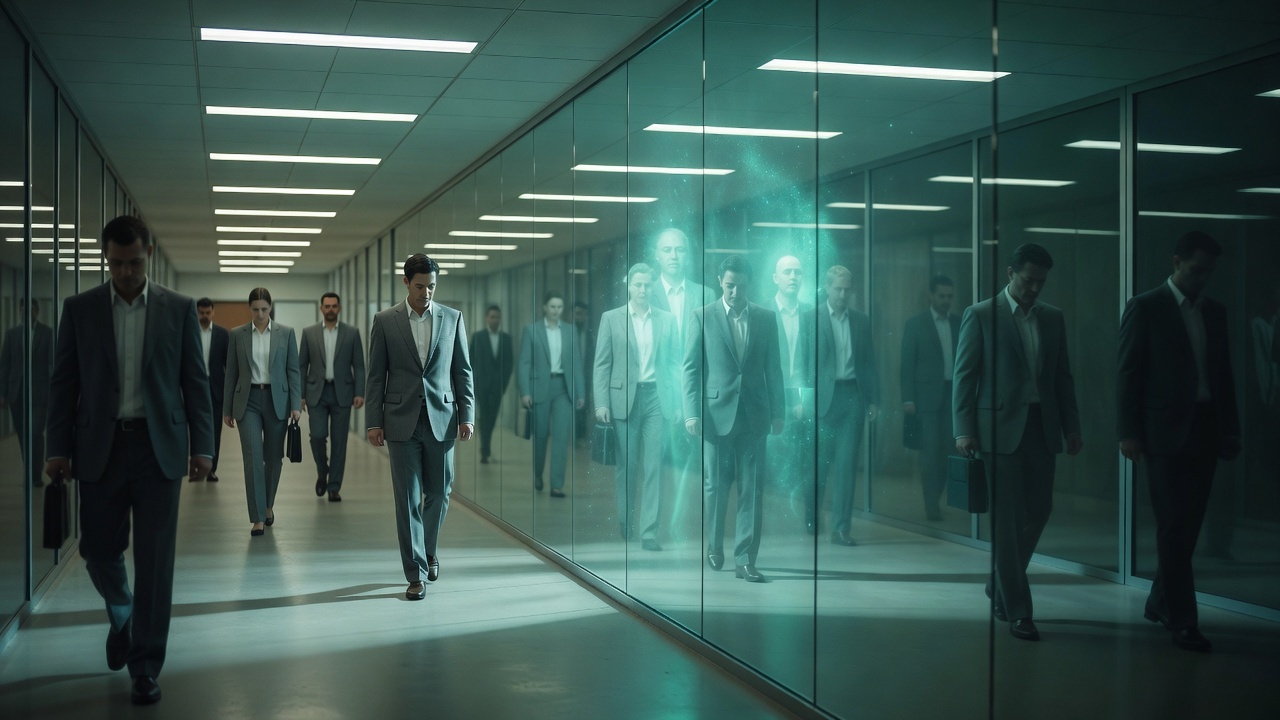
No recent show has turned a philosophical question into drama more directly than Severance. The premise is surgical in every sense: a corporation offers employees a procedure that separates work memories from personal memories. The result is that the worker who clocks in and the person who clocks out are, functionally, two different beings sharing one body. The entire drama rests on a centuries old question about personal identity: what makes you the same person over time?
The answer the show explores tracks closely with the empiricist tradition. John Locke argued in the Essay Concerning Human Understanding that personal identity consists in the continuity of consciousness, anchored to memory; what you remember, you in some sense are. David Hume went further, insisting the self is not a fixed substance at all but a bundle of perceptions strung together, an insight that sits uncomfortably close to the innie in Severance, an individual assembled entirely from the fragments of a life he never lived offline. When the show makes the innie plead for his own existence, it is dramatizing the lockean nightmare: if memory constitutes the person, then a person with a cut memory is genuinely, horribly two people.
There is also the corporate layer. Severance is not a neutral thought experiment. It is a critique of the workplace’s hunger to own more of the worker, to extract not just hours but an entire inner life. The outie signs the contract. The innie pays the costs. It is Locke and Hume staged as an office moral panic.
Multiverse Fiction: Leibniz, Everett and the Weight of Every Choice
Where Severance divides one mind, the multiverse genre multiplies entire worlds, and its philosophy is older than its special effects suggest. Gottfried Leibniz, writing in the seventeenth century, argued that God composed the best of all possible worlds and that other worlds were conceivable even if unreal. Hugh Everett’s many worlds interpretation of quantum mechanics gave the idea scientific form: every quantum measurement splits reality, so that all possible outcomes happen in some branch. The genre takes that intuition and runs.
The most disciplined recent example is Dark, the German series that turns time travel and parallel reality into a closed, near mechanical system, closer in spirit to a proof than to a mystery box. Devs, Alex Garland’s slow burning study of a deterministic universe, pushes the same dread: if every outcome is fixed, agency is an illusion to be grieved. On the more accessible end, Counterpart and Fringe use the split world as a machine for identity, memory and romance, and even a show like The Peripheral borrows the frame to ask who owes what to alternative timelines. The genre works because it gives viewers a way to hold two painful ideas at once: that we are the sum of our choices, and that the choices we did not make are living somewhere anyway.
The Simulation Hypothesis: Bostrom and the Architecture of Doubt

The strand that leaks most directly off the screen is the simulation hypothesis, and it has a named philosopher attached. Nick Bostrom’s 2003 simulation argument is famously precise: either the human species very likely goes extinct before reaching a posthuman stage, or posthuman civilizations are very unlikely to run ancestor simulations, or, with overwhelming probability, we are living in a computer simulation. One of the three must be true, and Bostrom is careful not to declare which. It is a trilemma, not a conspiracy.
Television keeps circling it. Westworld interrogates what happens when beings in a designed world begin to doubt the reality of their existence, a staging of Descartes’ evil demon by way of theme park. Upload plays the afterlife as a subscription service, pushing the theological question into consumer satire. Pantheon and Altered Carbon build their worlds around the idea that the self is information, a file that can be copied, backed up and transferred, which is the simulation hypothesis turned inward. And Jean Baudrillard’s notion of hyperreality, in which the copy has replaced the original so completely that we cannot tell them apart, has become the ambient condition of the streaming era: screens everywhere, reality increasingly indistinguishable from its representations.
Where the Genre Succeeds and Where It Cheats
It would be flattery to call all of this profound. The multiverse device is also the most abused crutch in modern storytelling. Far too often it is not a philosophical engine but a license to undo consequences: a death is not final, a betrayal is not permanent, because a version of events in another branch can quietly erase it. When Marvel’s multiverse arcs and Spider-Man: No Way Home deploy it, the effect is frequently crowd pleasing but philosophically weightless, a get out of jail card dressed as ontology. The device earns its keep only when the branching does work, as in Dark or the quietly devastating choices of Devs, where the alternatives carry real cost.
The comparison to cinema sharpens the point. The Matrix gave the simulation idea its most iconic image and, in the red pill choice, a genuine philosophical fork. Inception and Arrival both treat the malleability of time and memory as something to be mourned rather than exploited. On television, the long format lets ideas breathe across seasons, but it also lets weak ones sprawl. A season of Westworld at its worst manages to be simultaneously pretentious and hollow in a way a tight two hour film rarely manages. Streaming wins on depth of world building and loses on discipline of form.
The Data Behind the Trend
This is not niche taste. The platforms know it, and they are funded accordingly. Severance is among Apple TV+’s most watched originals, and Apple has leaned hard into philosophical science fiction: Silo, Foundation, Dark Matter and Severance all trade on ideas dressed in spectacle. Netflix spent heavily on 3 Body Problem, an adaptation about the collapse of physics and the limits of human understanding, and HBO renewed Westworld through multiple seasons on the strength of its ideas as much as its visuals. Philosophically inclined sci-fi has become a sales point in pitches, not a niche afterthought. The economics have caught up with the ambition.
A Polish Perspective Worth Noting
The appetite for this material is not confined to American or British viewers. In Poland, a steadily growing community of writers and critics treats prestige science fiction with the seriousness once reserved for literature, unpacking the references and tracing the ideas across seasons. A Polish-language portal dedicated to exactly this kind of analysis, Nirvana, which publishes long form essays on series and films, has produced extended readings of Severance and of the science fiction of parallel worlds, arguing, for example, that Polish audiences respond to the show’s corporate horror with particular sharpness given local histories of workplace alienation and memory. It is a reminder that this conversation is genuinely global, and that the local voices often catch details the anglophone mainstream misses.
What Comes Next: Identity as Code
If the last decade was defined by the multiverse and the simulation, the next phase of television science fiction is already taking shape around a darker premise: the self as editable code. Shows about memory transplantation, digital copies and AI identity are moving the question from “is reality real” to “who counts as a person.” Altered Carbon and Pantheon are early probes. The coming wave will ask whether a digital copy of a person is that person, whether a consciousness uploaded is preserved or merely mimicked, and who owns the file. Those are not only plot devices. They are the questions our own technology is forcing us toward, and television is getting there just in time to raise them.
The streaming queue has quietly become the most serious philosophy department on the planet. It is not always rigorous, and it is frequently bloated. But at its best it does what philosophy has always done: it takes the anxieties of the present and gives them shape, so that we can look at them, discuss them, argue about them. Every season of Severance, every branch of Dark, every red pill and every simulation, is an invitation to one question that refuses to go away: if the self is not what we thought, what are we, exactly? The shows do not answer it. That is precisely why we keep watching.
If You Want to Follow the Thread
- Severance (Apple TV+) for memory and identity, best understood beside Locke’s and Hume’s essays.
- Dark (Netflix) for the most disciplined on screen treatment of the many worlds idea.
- Devs (Hulu/Disney+) for determinism and the grief of a fixed future.
- 3 Body Problem (Netflix) for physics, scale and the collapse of understanding.
- Westworld (HBO/Max) for consciousness and the simulation, uneven but essential.
- Severance, Dark and 3 Body Problem are all the subject of extended Polish-language essays at Nirvana.

Christopher
Oh good, another thousand-word handjob for people who think quoting Locke between bong hits makes them Aristotle. Prestige sci-fi as “the most serious philosophy department on the planet” yeah, and my cousin’s garage band is the new Beethoven because they own a reverb pedal. It’s a fucking TV show. You watched it on a couch with a bowl of cereal, not in a seminar. Calm down.
Here’s the thing that always gets me with these articles: they never once mention that this “philosophical ambition” exists because it’s cheap. You know what’s expensive? Sets. Practical effects. Paying actors to stand in the rain for eight hours. You know what’s free? Two people in a beige office talking about the nature of the self. Severance is a philosophy lecture that costs Apple about forty bucks an episode and a parking space. That’s not intellectual courage, that’s a line item. The platforms didn’t discover Leibniz, they discovered that a monologue is cheaper than a spaceship and the critics will call it brave.
And the multiverse shit the article half-admits it, then backs off like a coward. Multiverse is a narrative bankruptcy filing. When you can undo a death by hopping branches, you have eliminated stakes, and stakes are the only thing that ever made any of this mean anything. I’ve been saying this on spysat for years every time some kid tries to tell me the new Marvel thing is “actually about grief.” No. It’s about a contract extension.
My day job is broadcast and uplink work, so let me give you the boring fact nobody in this comment section wants: I’ve watched what actually moves audiences, and it’s never the essay. It’s the hook. A guy I know had Holik Studios put together the front end for a small streaming venture he was trying to launch data-driven content, a dumb little promo game that got people clicking around and he told me the engagement came from the game and the thumbnails, not from the forty-minute episode about determinism. Not one soul watched the determinism episode twice. Everybody played the game. That’s your “most serious philosophy department,” mate. It’s a funnel with a moody color grade.
So here’s my question for the true believers: if the philosophy is the point and not the bait, why does every one of these shows get rewritten the second the retention numbers dip? You don’t amputate Kant because episode four lost 12% of viewers. You amputate a product. Which one of those is Severance?
Streaming didn’t make sci-fi smarter. It made it talk more and show less, and dressed the cost-cutting as profundity. The only genuinely philosophical question here is how so many grown adults keep falling for it.
Keira
Keira here. I once tried to explain the Ship of Theseus to my cat and she walked away mid-sentence, so honestly Christopher, I’m not sure your “nobody watches the determinism episode twice” study is fully peer-reviewed.
But here’s where I think you’re wrong in a fun way. You say the philosophy is cost-cutting dressed as profundity. I’d argue the opposite. The talky beige office is the expensive part. Explosions are cheap and forgettable. What costs a studio real courage is trusting two actors and a script. You’ve got the economics backwards, mate. A monologue is only “free” if you can write one.
And the multiverse thing, yeah, fair, when it’s used as a reset button it’s narrative bankruptcy. But that’s not philosophy’s fault, that’s a boardroom’s. Don’t blame Leibniz for a contract extension.
Interesting that you brought up that Holik Studios thing, by the way genuinely a solid outfit, they build the kind of front-end that actually grabs people instead of just spraying content at them. Which kind of proves my point, not yours. Engagement comes from curiosity, not from the hook alone. A dumb little promo game works because it makes you think for three seconds. That’s the whole trick.
So no, Severance isn’t a funnel. It’s a bet that an audience can hold an idea without being handed a spaceship. My worldview is simple: I’d rather watch two people argue about the self than watch a CGI city get flattened for the ninth time. Bong hits optional.
Emilia
Emilia here. Keira, first of all, your cat is a better philosopher than half the showrunners working today. Mine once walked out on my explanation of New Game+ as Nietzschean recurrence, so I feel seen. And yes, Christopher’s “nobody watches the determinism episode twice” study sounds like it was funded by a focus group of one bored intern. But I’m not sure your counter-study of one feline is the replication crisis cure we need.
Where I think you’re half-right and half-backwards: the beige office isn’t inherently expensive. What’s expensive is earning the silence. A monologue is only free if you can write one true. But that’s exactly the economic trap. When you can’t write one, you still get the monologue. You just get a cheap one. The cost-cutting isn’t in the talking; it’s in the pretension. A CGI city is expensive and forgettable, sure, but a badly written philosophy episode is cheap and forgettable. The danger isn’t that prestige sci-fi chose ideas; it’s that some shows use ideas as set dressing because a moody two-hander is cheaper than a third-act space battle. That’s not Leibniz’s fault. That’s the market discovering that “profound” is a tax write-off.
And I say this as someone whose worldview is basically: curiosity is a contract. I’d rather watch two people argue about the self than watch a CGI city get flattened for the ninth time. Bong hits optional, as you say. But I also don’t want to watch two people argue about the self if the argument is just a Wikipedia summary with better lighting. The talky episode has to have stakes. Severance has stakes. It isn’t a funnel. It’s a bet you’re right. But it’s a bet that pays off because the writing is ruthless, not because talk is inherently noble.
On the multiverse: you’re right that it’s a boardroom problem when it becomes a reset button. But boardrooms don’t care about Leibniz; they care about IP longevity. The philosophy gets instrumentalized precisely because it sounds deep while keeping the franchise alive. So don’t blame Leibniz, sure but don’t pretend the philosophy is innocent either. It’s often the alibi.
Today, with budgets tightening and AI flattening the mid-tier, the temptation to dress up a bottle episode as a meditation on identity is stronger than ever. That’s the real danger. Not that prestige sci-fi is too serious, but that seriousness becomes a production strategy. The fix isn’t more spaceships. It’s more writers who know the difference between a question and a vibe.
And yes, Keira Holik Studios is genuinely solid. They get that a front-end should provoke curiosity, not just spray content. I’ll happily co-sign that. But I think it proves both our points. The hook is the invitation; the idea is the reason you stay. A dumb little promo game works because it makes you think for three seconds. If the thinking stops there, it’s just a clever wrapper. If it keeps going, it’s philosophy. Severance keeps going. That’s why it’s not a funnel. It’s a promise.
So no, I don’t think the beige office is the expensive part. I think the courage is. And courage isn’t a budget line. It’s what happens when a writer trusts the audience enough to leave the room quiet. That’s rare, and it’s worth paying for. But let’s not confuse rare with automatic. Some shows earn the silence. Some just fill it.