What Paramount’s New Owners Are Really Building
Every generation of filmmakers gets a moment when the ground shifts under them and the industry pretends nothing happened. For mine, that moment arrived quietly, on a summer morning in 2025, when the studio that gave us Sunset Boulevard stopped being a family business and became a line item on a tech fortune. I have spent twenty years on sets and in development rooms, and I have never seen the mood inside a studio change as fast as it did at Paramount once the paperwork was signed.
This is not simply another merger. It is the moment a legacy Hollywood studio was re-underwritten by people whose first business is cloud infrastructure and whose second business is movies. What follows is what we know for certain, and then what I think it means for the rest of us.
The deal in numbers
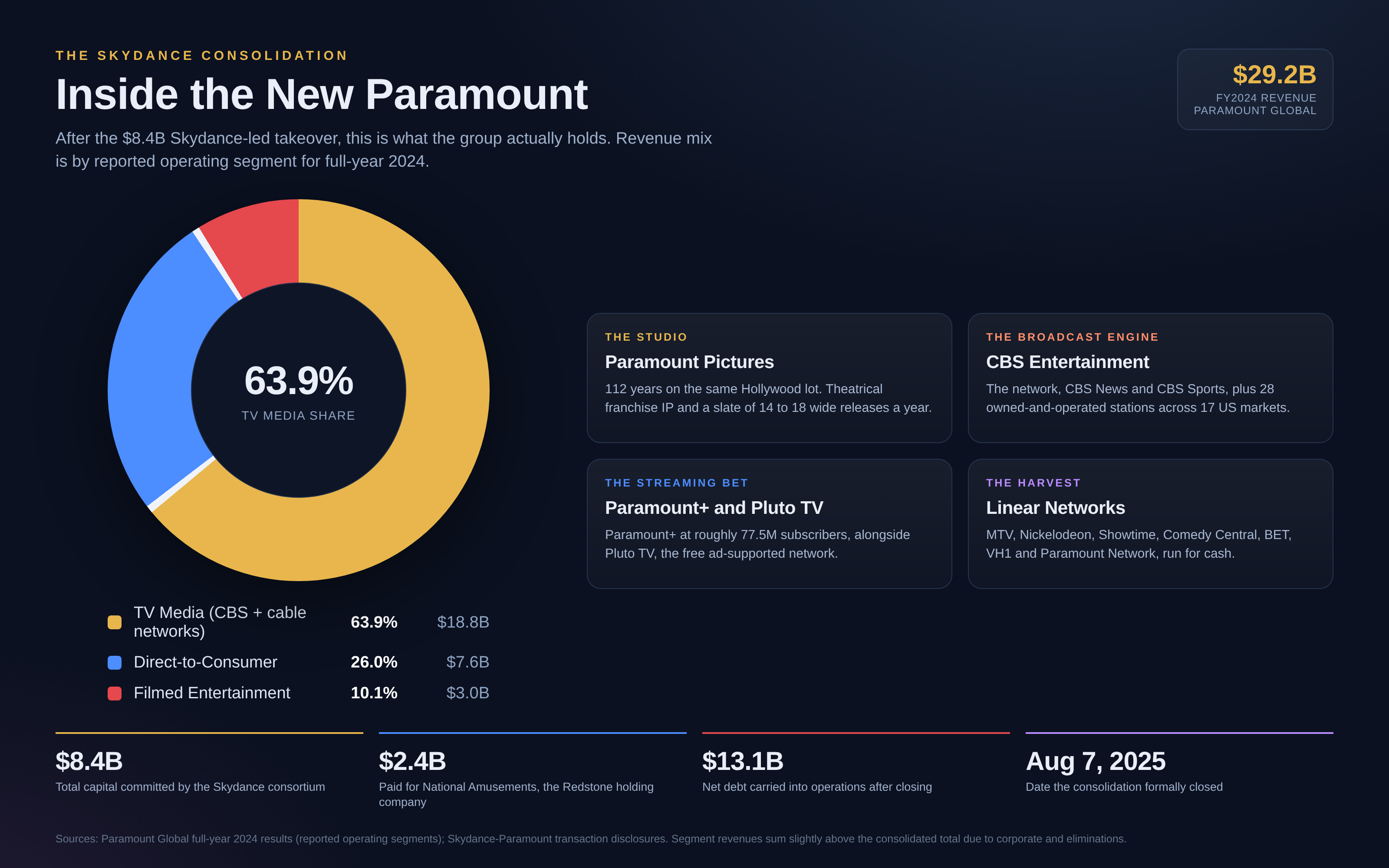
On August 7, 2025, the Skydance consortium formally closed its $8.4 billion acquisition and recapitalization of Paramount Global. The group brings together David Ellison, the Ellison family, and Gerry Cardinale's RedBird Capital Partners. The mechanics matter, because they explain everything the new owners are now under pressure to do.
RedBird and the Ellisons paid $2.4 billion for National Amusements, the Redstone family holding company that controlled the studio, and set aside $4.5 billion to buy out public shareholders. Class A holders were offered $23.00 a share in cash, or the option to roll into 1.5333 Class B shares. Class B holders were offered $15.00 in cash or a one-to-one roll. Another $1.5 billion went directly onto the corporate balance sheet to retire expensive debt. Skydance Media itself was folded in at a $4.75 billion equity valuation, paid in roughly 317 million newly issued Class B shares.
When the dust settled, the combined company, which insiders now simply call New Paramount, walked in with an enterprise value near $28 billion, an equity market value of about $19 billion, and, according to the deal math, around $13.1 billion in net debt.
That debt is the part everyone forgets. Paramount carried $14.6 billion in long-term debt before the deal, weighed down by rising interest rates and shrinking cable cash flows. Through 2024, S&P Global cut the company to BB+, junk territory, while Fitch and Moody's kept it pinned at the lowest investment-grade rungs on negative outlook. The clearest signal came on August 8, 2024, when Paramount booked a $5.98 billion non-cash goodwill impairment against its cable networks. When a company writes down nearly six billion dollars of value on MTV, Nickelodeon, BET, and Comedy Central, it is telling you what it thinks the future of those channels is worth. Everything since has been an attempt to act on that admission.
A studio underwritten by a tech balance sheet
Larry Ellison's family vehicles put in roughly $6 billion of the equity. RedBird added about $2 billion and the operational choreography. David Ellison took the chair and the chief executive's office. Jeff Shell, the former NBCUniversal chief, was named president and now runs the day-to-day machinery across networks, sports, news, and distribution. Shari Redstone, whose father built the empire, exited the board, the control, and the story.
What replaced her is something Hollywood had not seen before: a studio whose balance sheet sits on top of an enterprise computing company. This is the real novelty of the deal, and it reframes the entire competitive map. For decades, the power in this town belonged to legacy media families and the investment bankers who engineered their debt. Now a meaningful slice of it belongs to a software fortune with an interest in treating content as a high-visibility brand layer riding on top of cloud computing capacity.
I am old enough to be suspicious of that framing. Content has never liked being someone's layer. But the structure does buy New Paramount one thing the other studios are starving for: patience. A company insulated from the quarterly panic of debt covenants can survive a flop or two. In an industry where the wrong kind of leverage has killed more good studios than bad movies ever did, that is not a small advantage.
The new ownership structure sits on top of an enterprise computing business, which changes what kind of risk the studio is able to take.
The quiet retreat from the streaming arms race
Paramount+ enters this new era with roughly 71 million global subscribers, a respectable number and a strategically awkward one. It sits well below the scale that Netflix, Amazon, and Disney have demonstrated is necessary to make global direct-to-consumer streaming profitable. Everyone in the business knows that number is not a finish line. It is a debt.
So watch for the retreat to be dressed up as a partnership. The most likely path is wholesale: folding Paramount+ into some kind of multi-studio streaming venture, most obviously with Comcast's Peacock, bundling it with telecom carriers where the economics are friendlier, and recasting it as an international content hub that licenses its best originals to third-party platforms while keeping a lean, ad-supported footprint at home. Pluto TV, the free ad-supported service, suddenly looks less like a side project and more like the shape of the future the owners actually believe in.
For writers and producers, the practical consequence is subtle but real. When a platform is no longer trying to win a global subscription war, it stops ordering the kind of expensive, prestige-adjacent programming that was designed to lure subscribers. It orders what can play everywhere, cheaply, and travel well. That is a different creative brief, and it will be felt in the pitch meetings before it is ever visible to audiences.
Streaming stopped being a land grab and became a matter of who can afford to keep the lights on.
Cable as a harvest, not a home
The $5.98 billion write-down told us the plan for linear television, and the last two years have confirmed it. MTV, Nickelodeon, Comedy Central, BET, VH1, Showtime, and Paramount Network are now managed as harvesting operations. They generate cash, and that cash funds the things the owners actually want to build.
Scripted development on basic cable is effectively over at this studio. Those channels now serve as marketing funnels for theatrical releases, unscripted reality, and live events. The next logical moves, and I would bet on several of them, are spin-offs, joint ventures, or carve-outs that push the declining cable assets into separate vehicles, taking their debt with them and leaving the core studio and streaming balance sheet cleaner.
This is the part of consolidation that gets described in press releases as “focus,” and in the halls as “someone is losing their job.” Both are true.
A louder bet on theatrical
Here is where the new ownership may actually surprise people, and it is why I am not entirely pessimistic. Skydance's DNA is big-budget commercial cinema: Top Gun: Maverick, Mission: Impossible, Star Trek. David Ellison's team has spent years building franchises that live or die in theaters, and they understand, in a way that pure streaming operators often do not, that a hit movie still mints cultural currency that nothing else quite replaces.
The expectation inside the industry is that New Paramount preserves a robust slate of roughly 14 to 18 wide theatrical releases a year, a real commitment at a moment when several competitors have quietly trimmed their output to protect short-term margins. The long creative relationships with figures like Tom Cruise and Christopher McQuarrie give the studio something harder to buy than money: a reputation as a place where ambitious filmmakers want to work. During the long, ugly sale process, Paramount bled some of that reputation. Rebuilding it is one of the few genuine upsides of the Ellison era.
CBS and the price of live sports
Strip away the romance and CBS is the engine that keeps the lights on. Its value rests almost entirely on live sports, the NFL, March Madness, the Big Ten, plus live news, all of which deliver a reach that streaming still cannot replicate. CBS is also the promotional megaphone for Paramount Pictures' releases and for streaming tentpoles. That is a structural advantage no amount of algorithmic recommendation can substitute for.
The regulatory path to closing this deal ran straight through those assets. The transfer of control over 28 CBS owned-and-operated broadcast stations required FCC authorization under Section 310(d) of the Communications Act, and after public interest review and foreign-ownership certification tied to the Ellison trusts, the FCC approved the license transfers on July 24, 2025. Those commitments matter going forward, because they locked in continued investment in CBS News and the local stations, and they foreclosed the kind of wholesale station divestitures that financial buyers had floated. The price of owning a broadcast network, it turns out, is a promise to keep acting like you own a broadcast network.
The AI question nobody wants to answer
Here is the part I think about most, and the part that will define whether this era is remembered fondly or not.
Backed by Oracle, New Paramount is the natural test case for dragging enterprise-grade artificial intelligence into a legacy film pipeline. Expect proprietary cloud workflows across pre-visualization, automated localization and dubbing, visual effects rendering, and the subscriber analytics that studios increasingly use to decide what to make. In late 2025 and into 2026, the company migrated its streaming infrastructure, consumer analytics, and recommendation systems onto Oracle Cloud Infrastructure, replacing third-party multi-cloud contracts and claiming an estimated $350 million in recurring technology savings.
None of that is inherently sinister. Automated dubbing and faster rendering are the kind of boring efficiency that studios have pursued since the first editing bay. The friction arrives elsewhere, in intellectual property, in residuals, and in the quiet substitution of human labor. This is a stated pillar of the $2 billion in run-rate cost cuts the leadership promised, and it runs directly into the interests of SAG-AFTRA, the WGA, and IATSE. Every guild in town is watching how this specific studio handles consent, credit, and compensation for AI-assisted work, because whatever precedent New Paramount sets will become the template everyone else demands, or the warning everyone else cites.
I have spent my career arguing that technology belongs in the toolbox. I still believe that. But a tool that is deployed to shrink the number of people needed to make the thing is not just a tool. It is a decision about who gets to work, and it deserves to be negotiated in daylight rather than announced in an earnings call.
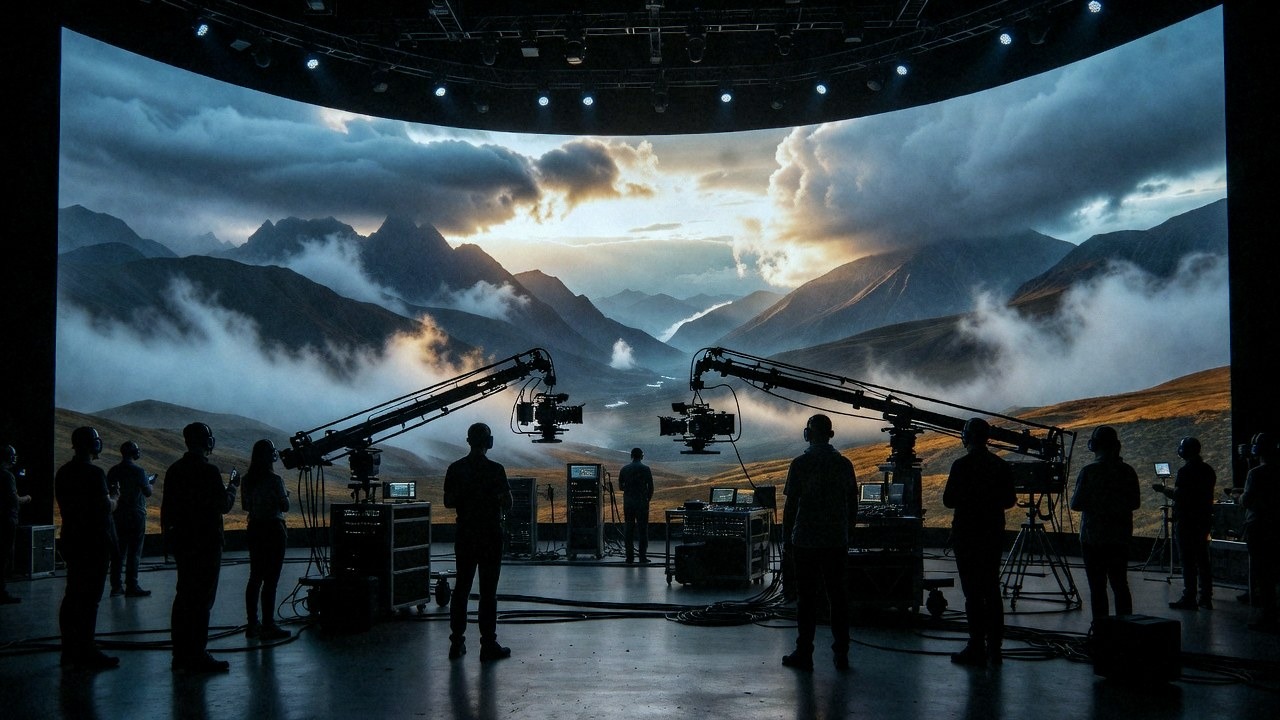
Virtual production and cloud rendering are already reshaping how, and where, films get made.
The next wave of consolidation
The completion of Skydance-Paramount has forced every other entertainment executive to look at their own balance sheet and feel nervous. Stand-alone mid-tier content owners can no longer comfortably absorb the twin pressures of linear collapse and the enormous fixed cost of streaming technology. The likely consequence is another round of defensive mergers, joint ventures, and asset carve-outs across the industry, with Warner Bros. Discovery and Lionsgate the names that come up most often in the speculation.
It is worth remembering how close we came to a different outcome. In December 2023, then-CEO Bob Bakish held exploratory merger talks with Warner Bros. Discovery's David Zaslav, and they stalled within weeks over WBD's own debt. In May 2024, Sony Pictures and Apollo pitched a competing $26 billion all-cash offer that withered under regulatory and foreign-ownership questions. That summer, Edgar Bronfman Jr. made a rival play for National Amusements, raising it to roughly $6 billion before walking away on August 26, 2024, when he could not secure binding financing. Paramount was, for most of a year, the most fought-over studio in town. The fact that it still ended up where it did tells you how little leverage the old model had left.
The people who feel it first
Consolidation is always described at the top and experienced at the bottom. The interim leadership that ran Paramount after Bob Bakish was pushed out in April 2024 executed a 15 percent reduction of the U.S. workforce, roughly 2,000 people, across marketing, communications, finance, legal, and operations. On August 13, 2024, the studio shuttered Paramount Television Studios outright, folding ongoing development and series like Reacher and Time Bandits into CBS Studios.
The strategic logic is clear: one consolidated slate for television production, one for global distribution, one for business affairs, one for marketing. The human logic is harder. Fewer series orders, smaller development budgets, thinner creative executive ranks, and more pressure on production fees. Nobody pledges to make fewer, bigger, safer bets as a slogan, but that is precisely what the structure now rewards.
What I would watch next
Three things will tell us whether this experiment becomes the blueprint or the cautionary tale.
First, whether Paramount+ merges or bundles. A genuine streaming joint venture would be the clearest admission that the standalone model is finished for everyone below the giants.
Second, who ends up holding the cable networks. If MTV and its siblings land in a separate debt-holding vehicle or a private equity portfolio, the harvest phase has begun in earnest, and the studio has drawn a line between its past and its future.
Third, how the AI conversation lands with the guilds. A negotiated, transparent framework would be genuinely new for this industry. A fight, or worse, a quiet workaround, would poison the well for years.
For twenty years I have watched this town convince itself that each disruption was temporary and that the old rules would return. They do not return. Paramount is now a tech owner's studio, and whether that is good or bad for the people who actually make films is still an open question. But it is no longer a hypothetical one. The merger is done, the debt is real, and the next studio in line is already looking for a way to survive the same storm. That is what consolidation ultimately does. It does not just change who owns the studio. It changes the terms on which the rest of us get to work.
A studio that has to prove it believes in movies
What strikes me most, in the end, is the contradiction the new owners have to live with. They bought a company built on spectacle for audiences who leave the house, and they are running it with the instincts of a business that would happily stream everything to the couch. The studios that survive the next decade will be the ones that resolve that contradiction honestly, by making the case for the theatrical experience and by treating the people who build it as partners rather than overhead.
Ellison's team has the money and, on paper, the patience. What it has not yet demonstrated is the thing that cannot be underwritten: taste, and the willingness to defend it when the quarter is bad. I will be watching the slate announcements more closely than the earnings calls. Movies, not spreadsheets, are how a studio tells you who it really is.

Brody
Agree: MTV/Nickelodeon’s $5.98B write-down then cloud buyout is town’s funniest insanity. AI consent? Ellison will negotiate or route around guilds. Bear Grylls BG-AC-1 on taplic.com still survives.
Emmanuel
Skydance can make theater an event, but cloud-owned AI risks smooth output with no human fingerprint. Holik Studios shows honest promos earn loyalty. Who gets authorship?