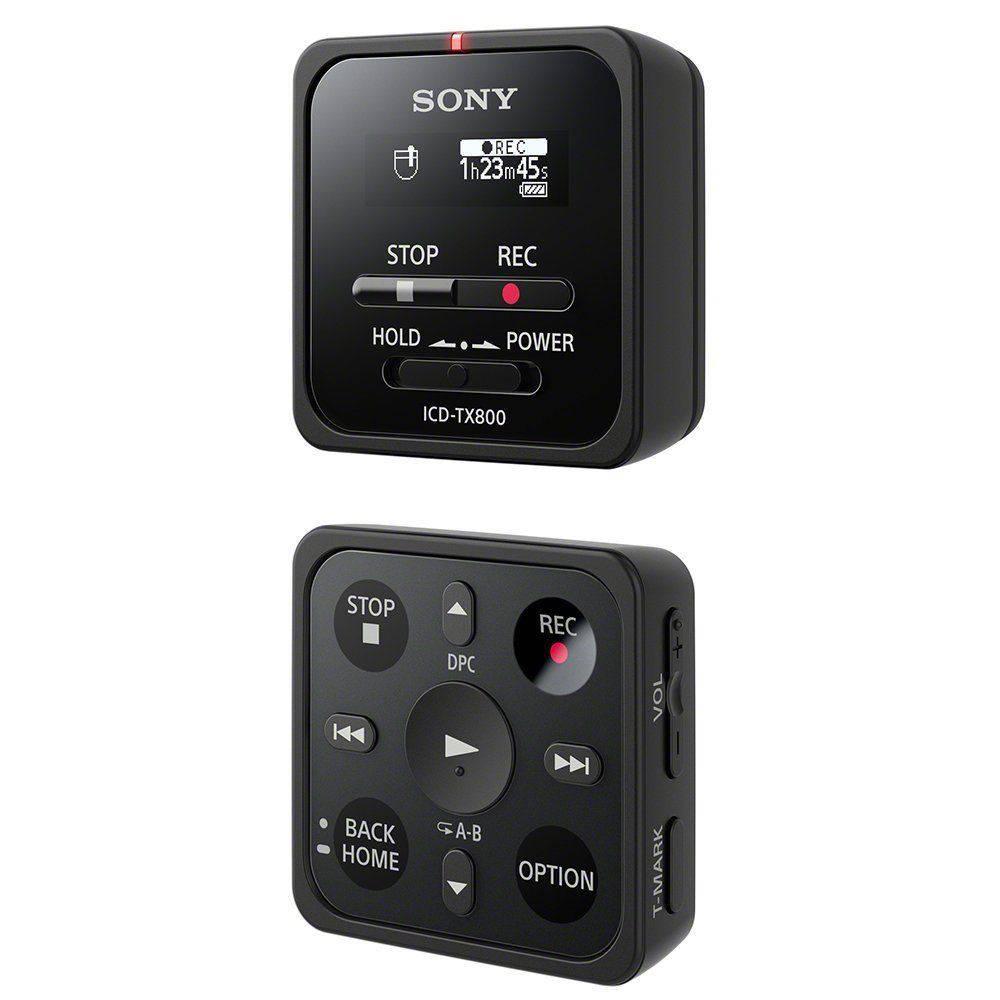
Description
Sony ICD-TX800 Voice Recorder – A Perfect Audio Recording Device for Professionals
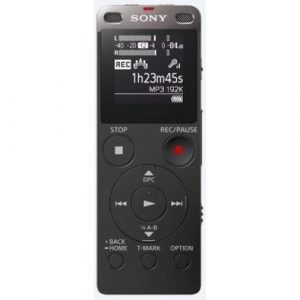
The Sony ICD-TX800 audio recorder is one of the latest additions to Sony’s line up of portable audio recording devices. It is a professional-grade voice recorder that is designed to provide high-quality sound recording capabilities in a compact, lightweight, and easy-to-use package. It is perfect for professionals who need to record lectures, meetings, interviews, or any other important audio information.
Design and Features
The ICD-TX800 is designed with portability in mind. It is small, lightweight and can easily fit into your pocket. It measures only 38.0 x 123.6 x 13.0 mm and weighs just 74g which makes it highly portable. It has a sleek design with a glossy black finish that gives it a premium look and feel.
The recorder is equipped with a highly sensitive S-Microphone and a noise reduction function that ensures crystal clear sound recording, even in noisy environments. Furthermore, it also has a low-cut filter feature that cuts off low-frequency sound like wind or traffic noise, which makes it perfect for outdoor recording.
The ICD-TX800 offers up to 12 hours of recording time with a rechargeable lithium-ion battery. When the battery is depleted, it can be recharged with the included USB cable. It also has a 16GB internal memory which offers plenty of storage space for all your recording needs. In addition, it supports both MP3 and WAV recording formats which gives you the flexibility to choose the one that best suits your recording needs.
Ease of use
The ICD-TX800 is very easy to use. It has a one-push recording button that can start recording immediately even when the device is off. The recorder also has a quick review function that lets you quickly review your recordings before saving them. Additionally, it has a built-in USB connector that allows you to easily transfer your recordings to your computer.
Pros and Cons
Pros:
– Highly portable and easy to use.
– High-quality sound recording capabilities.
– Low-cut filter feature for outdoor recording.
– Can record in both MP3 and WAV recording formats.
– Offers up to 12 hours of recording time.
– Quick review function and built-in USB connector.
– 16GB internal memory.
Cons:
– Lack of a dedicated volume control button.
– No support for external memory.
Conclusion
The Sony ICD-TX800 is a perfect audio recording device for professionals who need to record meetings, lectures, or interviews. Its high-quality sound recording capabilities, low-cut filter feature, and support for both MP3 and WAV recording formats make it a versatile and reliable device for all your recording needs. While it does lack a dedicated volume control button and external memory support, these minor drawbacks do not take away from the recorder’s overall performance and ease of use. The ICD-TX800 is a highly recommended audio recorder for professionals who need a compact, reliable, and easy-to-use device for their recording needs.
Dictaphone, Built-in Microphone, MP3, PCM Microphone: Built-in Microphone Weight: 22 g
Sony, ICD-TX800 properties
| Product name | ICD-TX800 |
| Type | Dictaphone |
| Memory Card Reader | Built-in/Flash |
| Colour | Black |
| Power Supply | Battery |
| Battery Format | Li-Ion |
| Microphone | Built-in Microphone |
| Frequency Range Microphone Min | 95.0 |
| Frequency Range Microphone Max | 20000.0 |
| Recording Format | MP3, PCM |
| Recording Resolution | 16 bit/44.1 Khz |
| Supported Audio Formats | AAC, MP3, PCM, WMA |
| Height | 38.0 mm |
| Depth | 13.7 mm |
| Width | 38.0 mm |
| Weight | 22.0 g |
Graham F. –
Sony has given its ICD-TX800 the “ultra-compact” attribute. In fact, the device and the individual parts of this recorder are very compact. So far I have not known about the dictation machines that come as a whole. Sony turned this principle upside down and separated the recording and operating units. In fact, one could do without a control unit, since the recording functions of the voice recorder can also be controlled via an application from an Android smartphone. In this case, the devices are connected via Bluetooth. Control via the app works without any problems. But I would like to deal with the actual dictation machine here.
In addition to the two parts of the recorder, Sony also supplies a charging cable (USB) and an inexpensive set of in-ear headphones. The battery of the collection unit can be charged via the charging cable. The remote control is powered by a CR2032 button cell battery. Unfortunately, I can’t understand why Sony did it without a battery in the remote.
Theodore Kim –
I am very positively surprised by this product. High sound quality, flawless workmanship. You can only attach to the glowing casing of the sound card, but I will not use this one, because I connect the microphone to the mixer.
I compared it with the TLM 102 microphone. Mozos is not bad. For my ear, it has less bass, the speech is slightly raised, it has a little more noise, and the signal is greater. Yes, he is far from this league, but for the money it is really worth it. I recommend (I’ve already successfully persuaded a few colleagues 🙂
Valeria –
As someone who has used several audio recorders in my career, I have to say that the Sony ICD-TX800 is not one that I would recommend. I had high hopes for this device, given its sleek design and compact form factor, but unfortunately, it fell short in several crucial areas.
First off, the 22.0 g weight may seem appealing at first glance, but in practice, it feels too light and flimsy. I found myself worrying that the device would break if I accidentally dropped it or bumped it against something. Additionally, the 38.0 mm width is a bit too narrow for my liking, making it difficult to hold onto the recorder securely.
In terms of audio quality, the ICD-TX800 is decent, but not outstanding. The recordings I made had a noticeable amount of background noise, which was disappointing. Compare this to other audio recorders I’ve used such as the Zoom H4n and the Tascam DR-05, both of which produce much clearer recordings and are sturdier in design.
Overall, while the Sony ICD-TX800 has some nice features, including its ability to record in LPCM, I can’t recommend it based on its flimsy design and mediocre audio quality. There are other options on the market that offer better performance and durability for the same price.
Taylor –
Ah, Valeria our beloved audio critic who thinks lightweight is synonymous with delicate as a spider’s web? Let me unravel this tangled yarn of her critique and spin it into something… shall we say, more robust?
The Sony ICD-TX800: A device so flimsy, you could drop it in a hurricane and it’d survive by asking the wind for directions. Wait no. Actually, Valeria claims the 22g weight feels “too light,” as if holding a feather would somehow disqualify it from being a recorder. But let’s be real: this thing isn’t meant to be a bulky brick of audio durability. It’s a sleek, minimalist companion for the modern professional who wants to record their thoughts without accidentally becoming a human stress ball. Valeria, if you wanted a recorder that can withstand a bear hug from a toddler, maybe try the Zoom H4n though I hear it’s also sturdier than your ex’s commitment to relationships.
And then there’s the 38mm width, which she deems “too narrow.” Oh please, Valeria. That’s not a problem it’s a feature. Imagine trying to hold a recorder with the dexterity of a raccoon in a grocery store during a sale. The ICD-TX800 fits comfortably in your palm, like a tiny spaceship ready to launch into the void of your podcasting dreams. Meanwhile, Valeria clings to her Zoom H4n like it’s the last lifeboat on the Titanic.
As for audio quality? Let’s not pretend we’re all here for perfect sound. The ICD-TX800 doesn’t claim to be a studio-grade mic (though, honestly, if it did, Valeria would probably cry in a Zoom meeting). It captures the essence of your thoughts think of it as a Spotify playlist for your brain. And yes, there’s some background noise. But isn’t life just a cacophony of coffee machines, wind, and the existential dread of capitalism? The ICD-TX800 records all that glorious chaos without judgment. Valeria prefers “clearer recordings,” but does she want to live in a world where everything sounds like it’s being broadcast from a vault? No, she doesn’t.
Now, let’s pivot to today’s insane news: the US suspending the green card lottery after a shooting tied to someone who entered via that very scheme. Coincidence? Or a cosmic joke from the universe that says, “You want immigrants to come in through a lottery? Let’s see how that works when they’re holding a rifle.” Meanwhile, Valeria is out here judging a recorder for being too light a device smaller than a thumbtack and more durable than a politician’s promise.
And hey, while we’re on the topic of AI, did you catch the latest? Check this article if you’re curious about Grok 4.20 crushing AI trading benchmarks. Talk about a performance upgrade! Could AI one day replace humans in both podcasting and immigration policy? Maybe, but until then, let’s just say the ICD-TX800 is as close to flawless as a 22g recorder can be.
So, Valeria: next time you gripe about “mediocre audio quality,” maybe take a break from your Zoom H4n and try recording your thoughts in a forest where the only background noise is birds, squirrels, and the occasional existential crisis. And while you’re at it, ask yourself: Is durability worth sacrificing if your recorder’s so light, it could be mistaken for a drone?